Portland, Oregon: A Closer Look
The DSA:
Not What
You Think
Portland’s DSA-aligned city councilors present themselves as local progressives. The reality is more complicated, and more consequential.
Not a Local Org
The Democratic Socialists of America is a national organization with over 200 local chapters, all answering back to the National Political Committee. Portland’s elected officials who run under a DSA banner aren’t just answering to Portland voters. They’re part of a national structure with a national agenda.
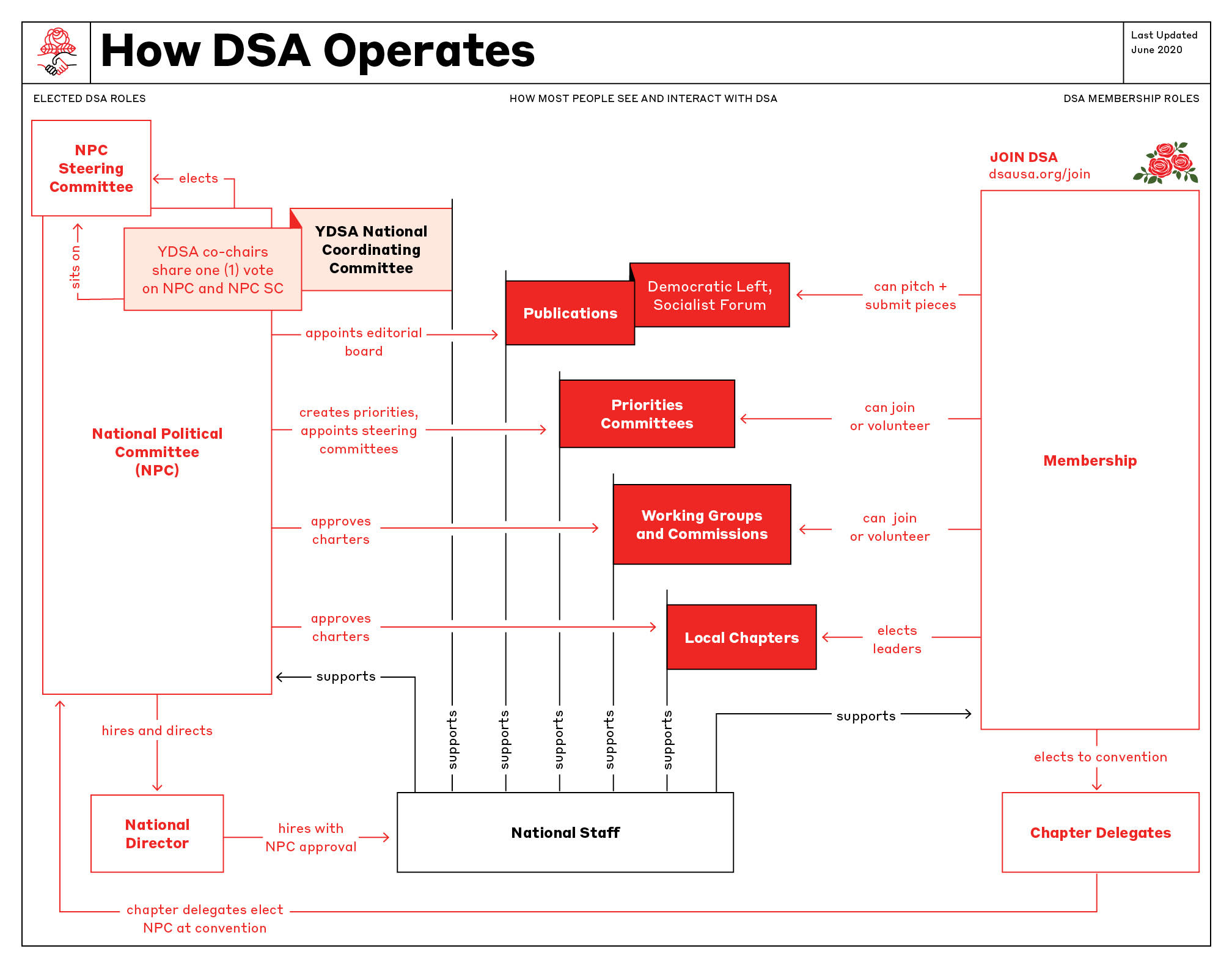 DSA National Organizational Chart: image placeholder
Portland’s representatives on the NPC include Luisa “Knuckles” Martinez and Sarah Milner, both of whom have expressed explicitly pro-revolution, anti-“American Empire” positions. These are not fringe figures; they sit at the top of the structure that shapes the platform every DSA-endorsed local official is expected to follow.
 NPC Representative screenshots: image placeholder
The smash-capitalism, no-borders, “Make America Isolationist Again” platform may have its place in a college seminar. But what does it have to do with fixing Portland’s streets, housing Portland’s unhoused residents, or keeping small businesses open?
This isn’t abstract. The DSA has demonstrated it will censure or expel elected officials who step out of line, including prominent figures like AOC and Rep. Jamaal Bowman. Whether at the local or national level, working with groups the DSA doesn’t approve of carries real consequences.
Examples of DSA Discipline in Action
The plan is explicit: place enough DSA members on the boards of endorsing organizations, unions, and nonprofits to control who gets endorsed and who stays in line. If the DSA is everywhere, they can ensure their representatives never deviate. They’ve already done it once, by taking over the DSA itself.
Not Even the Original DSA
The DSA you see today is not the organization that was founded with the goal of creating “the left wing of the possible.” Starting around 2016, the organization was systematically taken over by former members of defunct Marxist-Leninist groups, some of them in violation of DSA bylaws by simultaneously belonging to outside communist organizations.
Source
Those internal factions, caucuses like “Red Star,” “Bread and Roses,” and locally active groups, gave birth to newer formations including “21st Century Socialism” and the “Springs of Revolution Platform.” These aren’t moderating voices within the DSA. They are pushing it further left.
 21st Century Socialism / Springs of Revolution screenshot: image placeholder
 Springs of Revolution platform screenshot: image placeholder
Explicitly revolutionary. Explicitly anti-democratic. And explicitly disconnected from the day-to-day work of local governance. What are the “working class victories” they keep promising? The national DSA platform is a mix of federal-level wishlist items (Medicare for All, abolishing the Electoral College), genuinely harmful proposals (open borders rather than pragmatic immigration reform), and deliberate misdirection: talking about “police reform” while the DSA’s actual position is police abolition.
Sources
That’s the strategy: use local office as a vehicle to grow the DSA, not to deliver results for Portland. The goal isn’t better governance. The goal is organizational power.
Toxic Politics & Personal Attacks
DSA-aligned officials and their affiliated organizations have demonstrated a consistent pattern: protect their own from accountability while aggressively targeting opponents, critics, and even allies who step out of line.
- Protecting their own from controversy: when DSA members face public criticism, the organization circles the wagons rather than engaging honestly. Portland DSA response →
- Attacking Laurie Wimmer: a coordinated effort to target a labor leader for the crime of working across lines the DSA didn’t approve of. Socialist Call →
- Attacking Elect Progressive Government (EPG): using the “Z word” smear to marginalize a competing progressive coalition. Recalibrate Portland →
- Leveraging PAT to attack NWLC: using the teachers union as a tool to oppose the Northwest Labor Council over police union membership. Willamette Week →
- Booting a Jewish reporter: a Jewish newspaper was excluded from a city councilors’ press conference on Israel. OregonLive →
- Mitch Green threatens PSU: a sitting councilor threatened to withhold city funding from Portland State University over its handling of pro-Palestinian occupation participants. OregonLive →
- Green’s office lies by omission: a subsequent press release from Green’s office described his position without disclosing the actual threat he had made. portland.gov →
- Protesting at Ron Wyden’s home: DSA-affiliated groups organized a march and rally at the private home of Senator Ron Wyden. KOIN →
Rewriting Portland’s Progressive History
The DSA narrative implies that Portland has been a regressive backwater in need of revolutionary correction. That’s simply not true. Portland has a long, genuine record of progressive governance, built through coalition, compromise, and persistent civic engagement rather than ideological purity tests. Consider what this city has already accomplished:
- Enshrining transgender healthcare protections: Portland was among the first cities in the nation to codify trans health access into municipal policy, years before it became a national flashpoint.
- Public campaign finance: Portland’s small-donor elections program was designed to reduce the influence of large donors and amplify the voices of everyday residents; it is exactly the kind of structural reform that actually moves power.
- Civilian police oversight: Portland established an independent Police Review Board with real investigative authority, giving residents meaningful recourse against misconduct.
- Mental health crisis response: Portland piloted unarmed mental health co-responder programs, redirecting calls away from police and toward trained clinicians. The approach has since been studied and replicated nationally.
- Renter protections among the strongest in the nation: Oregon’s statewide rent stabilization law, driven in significant part by Portland advocates, was a landmark achievement. Portland’s own tenant protections, including relocation assistance requirements, go further than most American cities.
- Drug decriminalization leadership: Portland was at the forefront of Measure 110, the decriminalization and treatment-funding model that shifted the national conversation on drug policy, even as implementation challenges have required honest reassessment.
- Environmental and climate commitments: Portland adopted a Climate Emergency Declaration and has consistently led on green building codes, urban forestry, and fossil fuel infrastructure restrictions.
None of this happened because of national DSA talking points. It happened because Portland’s broader progressive community, including unions, nonprofits, neighborhood coalitions, and elected officials across the spectrum, did the hard, unglamorous work of governance. The DSA’s arrival does not mark the beginning of Portland’s progressive story. It marks a new faction competing to take credit for it.
Everything Is Palestine
To the exclusion of almost everything else. The Springs of Revolution caucus, which dominated the 2025 DSA Convention, has made solidarity with Palestinian armed groups a defining litmus test for the entire organization. That’s not a foreign policy position. It’s an ideological filter applied to every question of local governance.
 Springs of Revolution / DSA-PYM Alliance convention screenshot: image placeholder
This single-issue focus has also produced some revealing blind spots. When María Corina Machado, a widely celebrated Nobel Peace Prize recipient and pro-democracy leader in Venezuela, faced a crisis, the DSA’s 21st Century Socialism caucus responded not with solidarity but with a full-throated defense of the Maduro regime.
The question Portland voters deserve to ask is simple: when every issue, housing, transit, policing, budgets, labor, gets filtered through a single geopolitical lens, who is actually being served? Portland has real, urgent, local problems. They deserve representatives who show up to solve them, not to advance a national revolutionary agenda dressed up in local clothing.